


Signs Your Liver May Not Be Functioning Properly
Discover early signs your liver may not be functioning properly, including fatigue, jaundice and digestive issues, expert liver care in Noida.
24 Mar 2026
by Prakash Hospital
by Prakash Hospital

Woman holding upper abdomen with highlighted liver area indicating early liver damage symptoms
Liver cirrhosis is one of those conditions that develops quietly over years before announcing itself dramatically. Most people with early cirrhosis have no idea their liver is in trouble. By the time symptoms become unmistakable — jaundice, abdominal swelling, bleeding tendencies — substantial irreversible damage has often occurred.
In India, liver disease is now among the top causes of early adult death. The combination of viral hepatitis, alcohol use, and the rapidly rising rates of non-alcoholic fatty liver disease (linked to obesity and diabetes) has made cirrhosis common across all demographics — not just the heavy drinkers many people associate with it.
This article walks through what cirrhosis actually is, why it develops, the stages of progression, the warning signs at each stage, and the treatment options available.
Cirrhosis is the late stage of liver scarring (fibrosis). When the liver is repeatedly injured — by alcohol, viruses, fat accumulation, or other causes — it attempts to repair itself. The repair process produces scar tissue. Over years, healthy liver tissue gets progressively replaced by scar tissue.
This scarring causes several problems:
Blocks blood flow — scar tissue disrupts the normal flow of blood through the liver, raising pressure in the portal vein system (portal hypertension).
Reduces liver function — less healthy tissue means less production of proteins, less bile, less detoxification, less of everything the liver normally does.
Affects regeneration — the liver's remarkable ability to regenerate is impaired in cirrhosis.
Increases liver cancer risk — cirrhotic livers have substantially higher risk of developing liver cancer.
Cirrhosis is not the same as fatty liver or hepatitis (though those can lead to cirrhosis). It is the advanced stage where significant permanent scarring has developed.
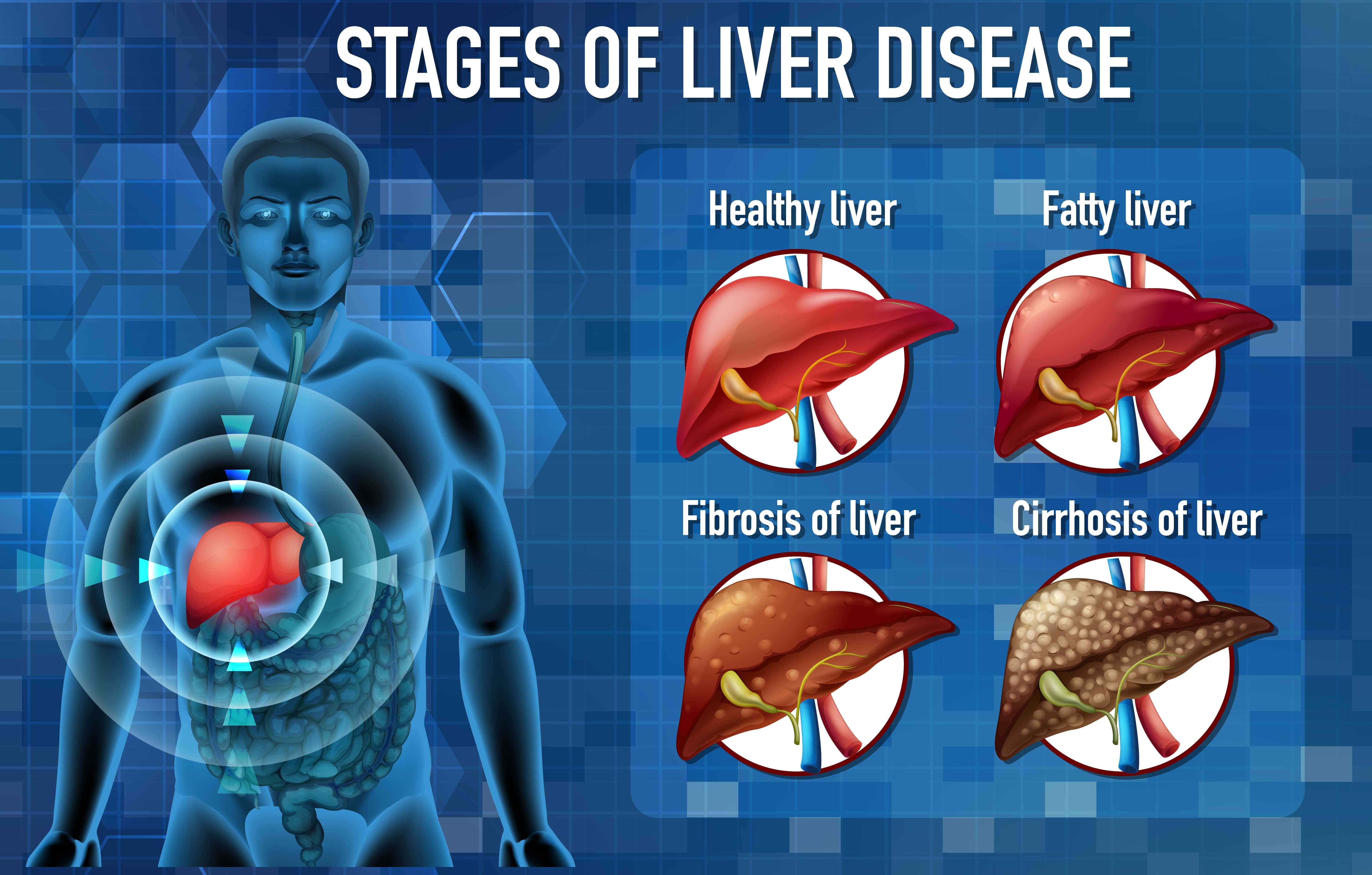
Doctors typically describe liver disease in four progressive stages:
The liver becomes inflamed from injury. Causes include fatty liver, hepatitis, alcohol, medications, or toxins. At this stage, the damage is fully reversible if the cause is addressed.
Persistent inflammation leads to scar tissue formation. Healthy liver tissue is gradually replaced by scar tissue. Blood flow through the liver becomes disrupted. With treatment of the underlying cause, fibrosis can stabilise or partially reverse.
Severe scarring throughout the liver. Healthy tissue is largely replaced by scar tissue. Liver function is significantly impaired. Symptoms become apparent.
Doctors further classify cirrhosis as:
Compensated cirrhosis — the damaged liver is still able to function, often without obvious symptoms. Many people are unaware they have cirrhosis at this stage.
Decompensated cirrhosis — the liver can no longer compensate. Complications develop — jaundice, ascites, encephalopathy, variceal bleeding.
The liver can no longer perform its essential functions. Without intervention (often transplantation), this is fatal.
Chronic heavy alcohol use is among the most common causes globally. The threshold varies by individual but includes:
Even moderate regular drinking causes some damage over years.
Fat accumulation in the liver, linked to:
NAFLD has become extremely common in India alongside rising obesity and diabetes rates. A portion of NAFLD progresses to NASH (non-alcoholic steatohepatitis) and then to cirrhosis.
Hepatitis B — chronic infection can lead to cirrhosis over decades.
Hepatitis C — chronic infection commonly progresses to cirrhosis if untreated. New antiviral medications now cure most cases.
Hepatitis D — requires co-infection with hepatitis B. Particularly aggressive.
The immune system attacks liver cells. More common in women. Treatable but can progress to cirrhosis if untreated.
Autoimmune destruction of small bile ducts in the liver.
Inflammation and scarring of bile ducts. Associated with inflammatory bowel disease.
Wilson's disease — copper accumulation in the liver.
Hemochromatosis — iron accumulation.
Alpha-1 antitrypsin deficiency — affects liver and lungs.
Cystic fibrosis — can affect the liver.
Long-term use of certain medications, high-dose vitamin A, and exposure to industrial chemicals.
Some traditional and herbal supplements have caused liver damage including cirrhosis.
Long-standing heart failure causes blood to back up in the liver, eventually causing damage.
Parasitic infection rare in India but relevant in some regions.
Often silent. When symptoms occur:
Many people in this stage feel essentially normal.
Risk factors, symptoms, alcohol use, medications, family history. Physical signs of liver disease.
Liver function tests — AST, ALT, ALP, GGT, bilirubin, albumin, PT/INR.
Complete blood count — often shows low platelets in cirrhosis.
Hepatitis screening — hepatitis B and C testing.
Autoimmune markers — when autoimmune hepatitis is suspected.
Specific tests for genetic conditions when relevant.
AFP (alpha-fetoprotein) — screening for liver cancer.
Ultrasound — shows liver size, texture, blood flow, ascites, and signs of cirrhosis.
FibroScan — measures liver stiffness, useful for diagnosing and monitoring fibrosis without biopsy.
CT or MRI — more detailed when needed.
A small tissue sample examined under a microscope. Gold standard for confirming cirrhosis when diagnosis is unclear.
Looking for esophageal varices (enlarged veins in the esophagus from portal hypertension) which can bleed catastrophically.
Severity scoring systems that help predict prognosis and decide transplant timing.
This is the single most important step. Stopping further damage allows the liver to stabilise.
For alcoholic cirrhosis — complete alcohol abstinence.
For viral hepatitis — antiviral medications (cures most hepatitis C, controls hepatitis B).
For NAFLD — weight loss, diabetes control, dietary changes.
For autoimmune hepatitis — immunosuppressants.
For Wilson's disease, hemochromatosis — specific treatments.
For drug-induced — stopping the offending drug.
Ascites — sodium restriction, diuretics, sometimes paracentesis (drainage), sometimes shunting procedures.
Variceal bleeding — endoscopic band ligation, medications to reduce pressure, emergency interventions for active bleeding.
Hepatic encephalopathy — lactulose, rifaximin, dietary protein adjustments.
Itching — specific medications.
Infection prevention and treatment — vaccinations, antibiotics for spontaneous bacterial peritonitis.
Nutritional support — addressing malnutrition common in advanced cirrhosis.
Avoid alcohol completely.
Adequate protein intake — important to prevent muscle wasting.
Sodium restriction — particularly with ascites.
Avoid raw shellfish — risk of serious infections.
Vaccinations — hepatitis A and B (if not immune), influenza, pneumococcal.
Careful medication use — many drugs need dose adjustments or should be avoided.
No smoking.
Manage other conditions — diabetes, hypertension, cholesterol.
Cirrhotic livers have substantially increased cancer risk. Regular screening with ultrasound and AFP every 6 months allows early detection.
For decompensated cirrhosis with severe complications, transplantation is often the only definitive treatment. India has well-developed transplant programs.
Outcomes depend on:
Compensated cirrhosis — many people live for years with minimal symptoms if the cause is addressed.
Decompensated cirrhosis — much shorter expected survival without transplantation.
Successful transplantation — survival rates have improved dramatically.
Catching cirrhosis early before complications develop transforms outcomes.
"Cirrhosis only affects alcoholics." NAFLD and viral hepatitis are common causes too. Many people with cirrhosis have never had a drink.
"You always feel sick with cirrhosis." Early compensated cirrhosis is often silent.
"Cirrhosis is always fatal." With proper management, many people live for years. Transplantation is often curative.
"Once you have cirrhosis, you cannot improve." Stabilising and partially reversing early cirrhosis is possible with addressing the cause.
"Liver tonics cure cirrhosis." No supplement or tonic cures cirrhosis. Medical treatment of the underlying cause is essential.
"You can drink moderately with cirrhosis." Complete alcohol abstinence is essential for all causes of cirrhosis.
"Diet alone cures cirrhosis." Diet supports treatment but does not replace it.
"Cirrhosis means imminent death." Many people live for years with cirrhosis. Outcomes vary widely.
A consultation makes sense when:
Annual liver function tests during routine checkups identify problems early when intervention is most effective.
Increasingly common because of NAFLD, viral hepatitis, autoimmune conditions, and genetic disorders. Do not assume cirrhosis is only for older people.
Liver disease during pregnancy needs specialised care. Pre-existing cirrhosis poses risks. Discuss before planning pregnancy.
Often combined with other conditions. Treatment approach must consider overall health.
NAFLD is much more common. Good glucose control is essential.
Weight loss is one of the most impactful interventions for fatty liver progression.
Liver disease is increasingly common in Delhi NCR. Multiple factors contribute — rising obesity and diabetes rates, alcohol consumption patterns in some demographics, exposure to traditional supplements without research backing, and lifestyle factors.
Practical adaptations include annual health checkups with liver function tests, weight management, moderating or eliminating alcohol, hepatitis vaccinations, careful medication use including avoiding unregulated traditional medicines, and gastroenterology consultation when concerns arise.
At Prakash Hospital, Noida, experienced gastroenterologists and hepatologists offer comprehensive evaluation including liver function tests, ultrasound, FibroScan, endoscopy when needed, and personalised treatment plans for various liver conditions including cirrhosis.
Whether you are in Sector 18, Sector 62, Greater Noida West, or anywhere nearby, Prakash Hospital Noida is a trusted name for liver care and gastroenterology.
To book a consultation, call the number.
Liver cirrhosis is a serious condition that develops slowly over years. Most cases are preventable through addressing the underlying causes — moderate alcohol use, weight management, hepatitis vaccination, careful medication use, and addressing metabolic factors.
For those who develop cirrhosis, the outcomes depend heavily on early detection and treatment. Compensated cirrhosis caught early and managed properly allows many years of relatively normal life. Decompensated cirrhosis is more challenging but increasingly manageable with modern treatments including transplantation.
The single most important message is to take your liver seriously. Annual blood tests during health checkups. Honest conversation with your doctor about alcohol, medications, and supplements. Address risk factors proactively. Get hepatitis vaccinations. Maintain a healthy weight.
If you are diagnosed with cirrhosis, follow your treatment plan strictly. Abstain completely from alcohol regardless of the cause. Take medications as prescribed. Attend regular follow-ups. Get cancer screening as recommended. Many people with cirrhosis live full meaningful lives. The key is partnership with your medical team and consistent attention to all the factors that affect liver health.

A swallowed pill camera that photographs the small intestine to find hidden bleeding or Crohn's disease.
A camera test of the large bowel that investigates bleeding or bowel changes and removes polyps early.
A camera test of the food pipe, stomach and duodenum for acidity, ulcers, bleeding and swallowing problems.
Free tools to check your weight, plan a pregnancy, track calories and more.
We offer expert care across key specialties, including Medicine, Cardiology, Orthopaedics, ENT, Gynaecology, and more—delivering trusted treatment under one roof.
Discover early signs your liver may not be functioning properly, including fatigue, jaundice and digestive issues, expert liver care in Noida.
24 Mar 2026
by Prakash Hospital

Hepatomegaly or enlarged liver — understand the causes, symptoms, and treatment options. Visit Prakash Hospital Noida for liver evaluation and care.
7 Jul 2026
by Prakash Hospital
Home remedies to strengthen the liver — foods, lifestyle changes, and natural approaches that support liver health. Visit Prakash Hospital Noida for liver care.
11 Jun 2026
by Prakash Hospital

Does dandruff cause hair fall? The link between scalp inflammation and hair loss — and how to treat both. Prakash Hospital Noida.
7 Sept 2026
by Prakash Hospital

Hair fall in women — hormones, PCOD, thyroid, iron deficiency, and more. Why women lose hair and what helps. Prakash Hospital Noida.
2 Sept 2026
by Prakash Hospital

How to stop hair fall with diet, lifestyle changes, and proven treatments. Indian-specific guide from Prakash Hospital Noida.
1 Sept 2026
by Prakash Hospital

Learn about high fibre foods, types of dietary fibre, digestive benefits, recommended intake, and how fibre prevents constipation and heart disease.
27 Feb 2026
by Prakash Hospital
लिवर खराब होने के शुरुआती लक्षण क्या हैं? थकान, पीलिया, पेट दर्द जैसे संकेतों को नज़रअंदाज़ न करें। कारण, जांच, इलाज और बचाव के तरीके जानें।
20 Feb 2026
by Prakash Hospital
Signs of liver problems — from early warning signs to serious symptoms. When to get tested and what the tests mean. Prakash Hospital Noida.
17 Sept 2026
by Prakash Hospital


Book a consultation with Prakash Hospital's specialists — 24/7 emergency care, 100+ doctors, NABH accredited.
View All Departments