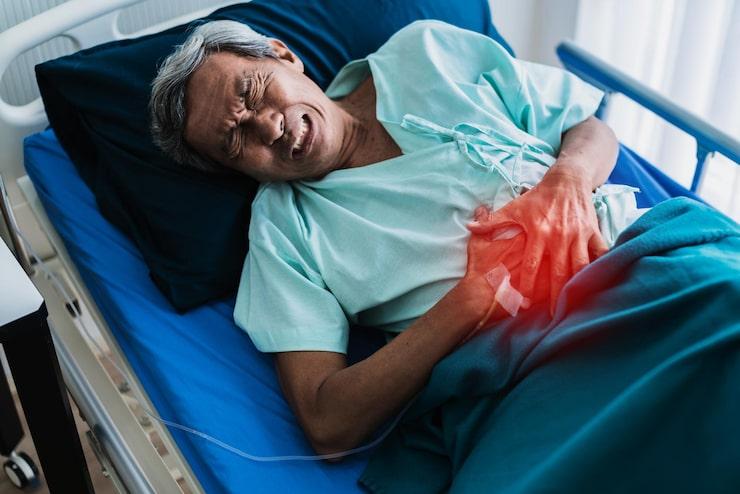
man suffering from stomach ulcers
Peptic ulcers are open sores that develop on the inner lining of the stomach or the upper small intestine (duodenum). They're more common in India than in most Western countries, driven largely by the very high prevalence of Helicobacter pylori infection (the bacteria responsible for the majority of peptic ulcers) and the widespread use of NSAIDs (ibuprofen, diclofenac, aspirin) — often without a doctor's prescription.
Understanding the symptoms of a peptic ulcer — and distinguishing them from ordinary acidity — matters because untreated ulcers can progress to serious complications, including bleeding and perforation.
Gastric ulcer: on the lining of the stomach itself. Pain typically worsens with eating (the food stimulates acid production against the raw ulcer).
Duodenal ulcer: on the first part of the small intestine (duodenum), which connects to the stomach. More common than gastric ulcers. Pain characteristically improves with eating (food buffers the acid) and returns 2–3 hours later as the meal is cleared and acid production continues.
Burning or gnawing upper abdominal pain: the most characteristic symptom. Felt in the epigastric region — the central upper abdomen, between the breastbone and navel. The burning or gnawing quality reflects the acid contacting the raw ulcer surface.
Hunger-like pain in the middle of the night: duodenal ulcers are notorious for producing pain in the early hours of the morning (typically 2–4 am) — when the stomach is empty, acid production is high, and there's no food to buffer it. The person wakes with gnawing pain that is relieved by eating or drinking milk.
Relief with food, milk, or antacids (duodenal ulcer): this is the distinctive feature of duodenal ulcer — eating temporarily buffers the acid and relieves pain. Relief is short-lived (1–2 hours) as acid production continues.
Worsening with food (gastric ulcer): gastric ulcer pain may worsen with eating because food stimulates acid secretion against the ulcerated stomach wall.
Nausea: common; some people also experience vomiting.
Bloating and fullness: the stomach can feel uncomfortably full even after small meals.
Belching: from increased acid production and gas.
Indigestion (dyspepsia): a general sense of upper abdominal discomfort, heaviness, and poor digestion.
Poor appetite and weight loss: pain associated with eating leads some people to eat less; weight loss follows.
Not just ordinary acidity: acid reflux (heartburn) is a burning sensation that rises toward the throat. Peptic ulcer pain is typically more localised to the upper abdomen, more clearly related to meal timing, and more likely to wake from sleep.
Not sharp or stabbing: the pain of an uncomplicated ulcer is typically burning or gnawing — not sharp and sudden. Sharp sudden pain can indicate a complication (perforation).
H. pylori infection: responsible for approximately 70–80% of duodenal ulcers and 60–70% of gastric ulcers. H. pylori is a bacteria that lives under the stomach mucus layer and damages the protective mucosal lining, allowing acid to cause ulceration. Prevalence in India is very high — 40–70% of adults. Transmitted by the fecal-oral route (contaminated water and food).
NSAIDs (ibuprofen, aspirin, diclofenac, naproxen): inhibit prostaglandin synthesis. Prostaglandins maintain the protective mucus layer of the stomach lining. Without them, the lining is vulnerable to acid damage. NSAID-induced ulcers are the second most common cause — and represent a significant concern in India where NSAIDs are frequently self-prescribed without understanding the gastric risk.
Less common causes: Zollinger-Ellison syndrome (a rare tumour that causes extremely high acid production), excessive alcohol, stress in critically ill patients.
What doesn't cause ulcers: spicy food and emotional stress do not cause peptic ulcers, though they may worsen symptoms in people who already have ulcers.
Bleeding ulcer: the ulcer erodes into a blood vessel in the stomach wall. Presents as:
This is a medical emergency — call for help or go to the nearest emergency room immediately.
Perforated ulcer: the ulcer erodes completely through the stomach wall, spilling contents into the abdominal cavity. Causes sudden, severe, "board-like" abdominal pain — often described as the worst pain of the person's life. Peritonitis (abdominal infection) follows rapidly. Surgical emergency.
Gastric outlet obstruction: repeated ulceration and scarring can narrow the stomach outlet, causing early satiety, nausea, and vomiting of undigested food. Rarer in the H. pylori treatment era.
Upper GI endoscopy (gastroscopy): the definitive investigation. A flexible camera is passed into the stomach and duodenum under sedation. Directly visualises the ulcer, takes biopsies (to test for H. pylori and rule out cancer in gastric ulcers), and can apply treatment (endoscopic haemostasis for bleeding ulcers).
H. pylori testing: urea breath test (non-invasive, accurate — the patient drinks a urea solution; if H. pylori is present, it breaks the urea and the exhaled air contains labelled carbon dioxide); stool antigen test (simple, reliable); serology (blood antibody test — positive after past infection, less useful for active infection).
Barium meal X-ray: less common now; shows ulcer crater but less informative than endoscopy.
H. pylori eradication: the cornerstone of treatment when H. pylori is the cause. Triple therapy is the standard:
Successful H. pylori eradication cures 90–95% of H. pylori-caused ulcers and dramatically reduces relapse.
Acid suppression: proton pump inhibitors (omeprazole, pantoprazole) or H2 blockers (famotidine) suppress acid, allowing the ulcer to heal. Used for 4–8 weeks.
NSAID-induced ulcers: stop the NSAID if possible; use the lowest effective dose if it must continue; add a PPI with it; switch to a COX-2 selective NSAID (etoricoxib, celecoxib) which is less ulcerogenic.
Dietary modifications: while diet doesn't cause ulcers, certain modifications reduce symptom severity during healing. Eat regular small meals; avoid spicy food, alcohol, coffee, and carbonated drinks while the ulcer heals; don't smoke (smoking impairs mucosal healing).
Antacids: for symptomatic relief — not for healing.
Don't take NSAIDs without medical supervision if you have a history of ulcers or H. pylori infection.
At Prakash Hospital Noida, our gastroenterologists provide H. pylori testing, upper GI endoscopy, and comprehensive ulcer treatment including appropriate antibiotic regimens for H. pylori eradication and acid suppression therapy. Emergency endoscopy for bleeding ulcers is available.
Whether you live in Sector 18, Sector 62, Greater Noida West, or anywhere in the NCR, Prakash Hospital Noida is a trusted name for peptic ulcer treatment, gastroenterology, and digestive health in Noida.
To book a consultation, call the number.
Tags: #PepticUlcerSymptoms #StomachUlcerIndia #PrakashHospitalNoida
 Copy
CopyWe offer expert care across key specialties, including Medicine, Cardiology, Orthopaedics, ENT, Gynaecology, and more—delivering trusted treatment under one roof.

Dr. Abhishek


Book a consultation with Prakash Hospital's specialists — 24/7 emergency care, 100+ doctors, NABH accredited.

Prakash Hospital Pvt. Ltd. is a 100 bedded NABH NABL accredited multispecialty hospital along with a center of trauma and orthopedics. We are in the service of society since 2001.
OUR SPECIALITIES
Patient Services
PROCEDURES
Contact Us
D – 12A, 12B, Sector-33, G. B. Nagar, Noida, Uttar Pradesh 201301
+91-8826000033


© 2026 All rights reserved.
Designed and Developed by Zarle Infotech