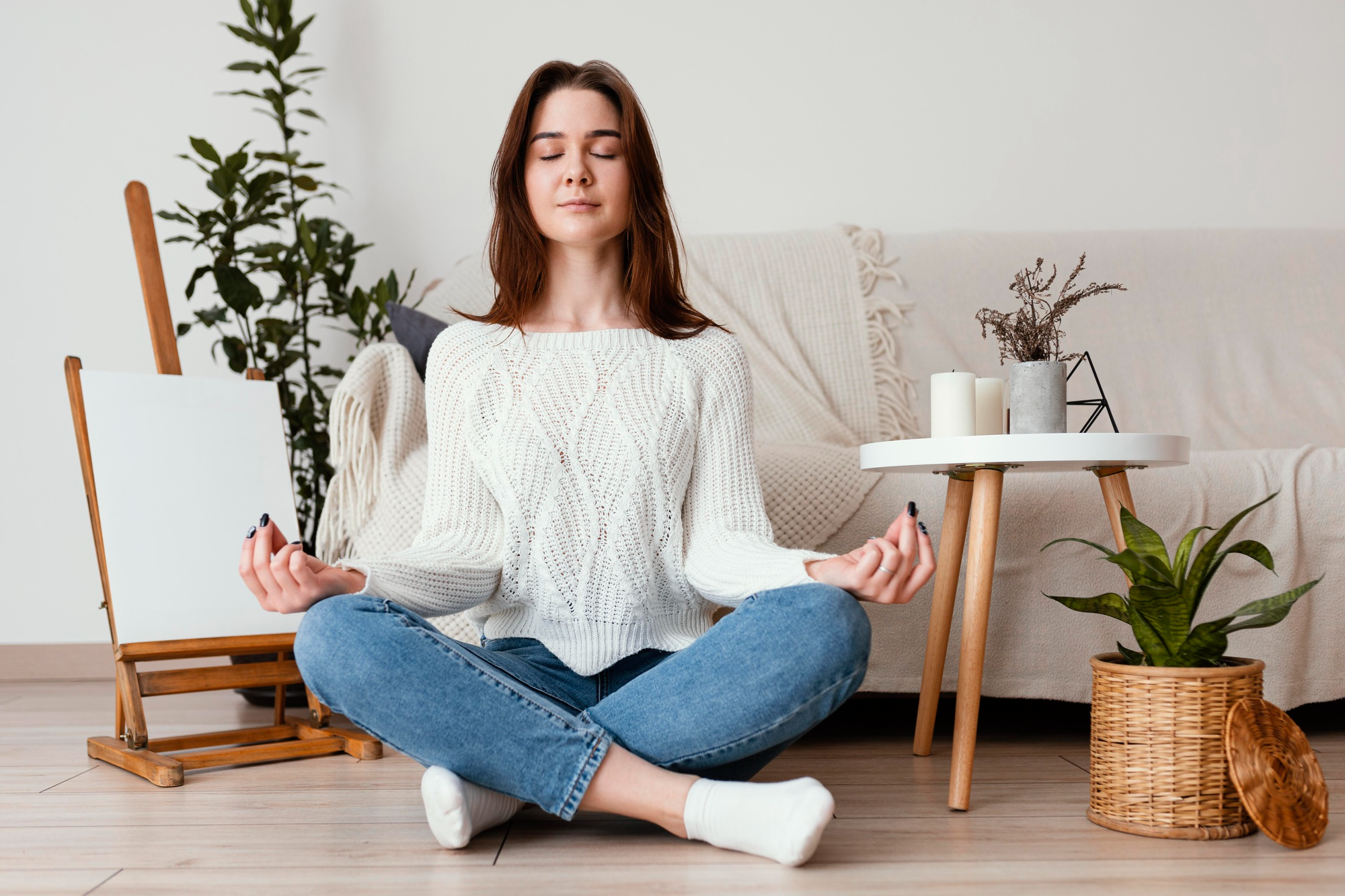
A calm woman sits cross-legged, eyes closed, practicing deep breathing techniques to relieve stress and anxiety and promote mental well-being.
Everyone feels anxious. Anxious before a presentation, worried about a health scare, fearful before a difficult conversation. Anxiety is a functional emotion — the same system that kept our ancestors alert to genuine danger.
Clinical anxiety is when this system runs on overdrive without adequate cause, or runs so persistently that it disrupts life. When worry is constant and uncontrollable. When the anxiety is out of proportion to the actual situation. When it's preventing normal functioning. At that point, it's a medical condition, not a personality trait.
Anxiety disorders are the most common mental health conditions globally. They respond very well to treatment — both psychological and, when needed, medical.
Recognising Anxiety: More Than Just Worry
Anxiety shows up differently in different people. Common manifestations:
Generalised anxiety disorder (GAD): persistent, excessive worry about multiple areas — health, money, relationships, work, safety — that's difficult to control. Accompanied by physical tension, restlessness, fatigue, difficulty concentrating, and sleep problems.
Panic disorder: recurrent unexpected panic attacks plus significant worry about having more. (Covered in detail in the panic attack blog in this series.)
Social anxiety: intense fear of social situations and being judged or embarrassed. Goes beyond ordinary shyness — can prevent attending events, making phone calls, speaking in meetings, eating in public.
Health anxiety (hypochondria): excessive worry about having or developing a serious illness, disproportionate to medical evidence. Medical reassurance relieves worry only temporarily.
Specific phobias: intense fear of specific things — heights, flying, injections, spiders — that causes significant avoidance.
Separation anxiety: in adults, intense anxiety about separation from specific attachment figures.
Across all types, common physical symptoms include:
Sleep difficulties (difficulty falling asleep, mind racing at night)
The Anxiety Maintenance Loop
Understanding why anxiety persists even when nothing bad happens is helpful.
Anxiety produces an urge to avoid or escape the feared situation. Avoidance provides short-term relief, which reinforces the avoidance behaviour. But avoidance prevents the person from learning that the feared situation is actually manageable or safe. So anxiety about it stays high or grows.
This is why treatment that involves facing fears (exposure) — however counterintuitive — is central to actually resolving anxiety rather than just managing it.
Evidence-Based Approaches That Work
1. Breathing techniques for immediate relief
Slow breathing activates the parasympathetic nervous system and lowers cortisol within minutes. This doesn't resolve anxiety disorder, but it manages acute symptoms and can prevent panic attacks from escalating.
4-7-8 breathing: Inhale for 4 counts, hold for 7, exhale for 8. Repeat 3–4 times.
Physiological sigh: double inhale through the nose, long exhale through the mouth. Fastest-acting.
Practice when calm so the technique is available when anxious.
2. Regular exercise
Exercise is one of the most evidence-supported interventions for anxiety. Several mechanisms: it metabolises stress hormones (adrenaline and cortisol), it promotes GABA (an inhibitory neurotransmitter that reduces anxiety), it raises endorphins, and it improves sleep.
30 minutes of moderate aerobic exercise (brisk walking, cycling, swimming) five days a week produces anxiety reduction comparable to medication for mild to moderate generalised anxiety — and unlike medication, the effect is durable.
3. Cognitive Behavioural Therapy (CBT)
CBT is the gold-standard psychological treatment for anxiety. It works by:
Identifying automatic negative thoughts and anxiety-maintaining thinking patterns
Examining the evidence for and against them
Developing more realistic, balanced interpretations
Gradually facing feared situations (exposure) rather than avoiding them
Typically 8–20 sessions with a trained therapist. CBT produces changes in brain structure — the neural pathways maintaining anxiety can be literally rewritten with enough practice.
In India, CBT access is growing but still limited outside major cities. Online CBT platforms (apps like Woebot, or online therapist platforms) make it more accessible.
4. Mindfulness and mindfulness-based CBT
Mindfulness — deliberately attending to the present moment without judgment — changes the relationship with anxious thoughts. Rather than being caught inside the thought ("what if something goes wrong"), the observer notices it ("there's that thought again") and lets it pass.
Mindfulness-Based Cognitive Therapy (MBCT) is specifically designed for anxiety and depression and has strong evidence.
Apps like Headspace, Calm, and Insight Timer provide structured mindfulness programmes. Ten to twenty minutes daily for 8 weeks produces measurable changes.
5. Sleep
Anxiety disrupts sleep. Sleep deprivation worsens anxiety. The relationship is bidirectional and self-perpetuating. Addressing sleep — consistent timing, screen-free evenings, cool room, no caffeine after 12 pm — often meaningfully reduces anxiety. Not as a substitute for treatment, but as a necessary foundation.
A person laying in bed looking at sleeping pills on the bedside table, reflects the use of medication to manage sleep disorders and the importance of consulting a doctor.
6. Reduce caffeine and alcohol
Both are anxiety amplifiers. Caffeine directly raises adrenaline and mimics the physiological state of anxiety — rapid heart rate, alertness, arousal. Sensitivity varies, but people with anxiety who reduce or eliminate caffeine consistently report lower baseline anxiety.
Alcohol is tempting as a short-term anxiolytic (it temporarily reduces anxiety through GABA activation), but rebound anxiety during withdrawal — even from a single drink — is common. Chronic alcohol use significantly worsens anxiety.
7. Worry time and brain dump
For GAD specifically: schedule 15–20 minutes daily of deliberate worry — sit down, write out every worry, consider each one. When worries arise outside this time, note them down and defer them to the scheduled time.
This sounds counterintuitive but works by giving worry a defined container, reducing the random intrusion of anxious thoughts throughout the day.
Before bed, write tomorrow's to-do list. Getting thoughts out of the head reduces the mental circling that prevents sleep.
8. Social connection
Anxiety thrives in isolation. Regular interaction with trusted people — particularly honest conversations about how you're feeling — is protective. Social support reduces perceived threat and provides reality testing for anxious thoughts.
9. Reduce news and social media consumption
The anxiety loop of news consumption — checking for updates, reading alarming content, feeling more anxious, checking again — is well-documented. Social media comparison also drives anxiety. Specific limits (not after 8 pm, not before 9 am, only twice a day) help more than vague intentions to "use less."
When Medication Helps
Lifestyle and psychological approaches are primary. Medication is appropriate when:
Anxiety is severe enough to prevent engagement with therapy
Lifestyle approaches haven't produced adequate relief
There's a significant impact on function (work, relationships, daily activities)
The anxiety is accompanied by depression (common — they coexist in about 50% of cases)
SSRIs and SNRIs (escitalopram, sertraline, venlafaxine): first-line medication treatment. Anti-anxiety effects develop over 2–4 weeks. Usually continued for 12 months after the anxiety stabilises. Don't cause addiction in the traditional sense.
Buspirone: specific anti-anxiety medication, non-addictive, takes weeks to work. Less commonly used because SSRIs are versatile.
Short-acting benzodiazepines (clonazepam, alprazolam): rapid, effective anxiety relief. Reserved for short-term use or specific situations (flight anxiety, medical procedures) because of tolerance and dependence risk with regular use.
Beta-blockers: manage physical symptoms of anxiety (heart racing, trembling) for specific situations like public speaking. Don't treat the underlying anxiety.
Medication works best combined with therapy. Therapy produces the durable changes; medication reduces symptom severity enough to engage with therapy.
Drinking alcohol to manage anxiety: short-term relief, worsening long-term.
Suppressing anxious thoughts: suppression paradoxically increases intrusion (try not to think about pink elephants).
Waiting for anxiety to go away on its own: for anxiety disorders, it rarely does without treatment.
When to See a Doctor
Seek evaluation when:
Anxiety is persistent (most days for weeks)
It's affecting work, relationships, or quality of life
You're avoiding significant activities because of anxiety
Physical symptoms (chest pain, palpitations, headaches) are prominent — rule out medical causes first
Sleep is significantly disrupted
You're using alcohol or substances to cope
Depression accompanies the anxiety
Panic attacks are occurring
A GP can do initial assessment, rule out contributing medical conditions (thyroid, glucose), and refer to a psychiatrist or psychologist. Mental health referral in India carries less stigma than it did even ten years ago — getting evaluated is a practical, sensible step.
A Practical Toolkit for Daily Anxiety Management
Morning: 10 minutes of breathwork or meditation before reaching for the phone.
Exercise: 30 minutes most days. Non-negotiable.
Caffeine: before midday only, and notice whether reducing it helps.
Throughout the day: notice anxious thoughts without engaging with them fully. Name them: "there's that worry again." Don't fight them, don't follow them.
Worry time: 15 minutes in the afternoon. Write everything down. Close the notebook.
Evening: no news or social media after 8 pm. Wind-down routine.
Before sleep: tomorrow's task list written out. Phone out of the bedroom.
This structure won't resolve an anxiety disorder on its own, but it changes the daily environment in ways that reduce baseline anxiety and support whatever therapeutic work is happening.
Care at Prakash Hospital Noida
At Prakash Hospital Noida, our physicians evaluate anxiety through clinical assessment and blood tests (thyroid, blood glucose, vitamin D — all of which can contribute to anxiety symptoms). Referral to mental health specialists — psychiatrists and psychologists — for assessment and treatment is available. We provide a straightforward, non-judgmental starting point for people beginning to address anxiety.
Whether you're in Sector 18, Sector 62, Greater Noida West, or anywhere nearby, Prakash Hospital Noida is a trusted name for general health, mental health screening, and wellness care in Noida.
We offer expert care across key specialties, including Medicine, Cardiology, Orthopaedics, ENT, Gynaecology, and more—delivering trusted treatment under one roof.
Prostate problems — symptoms of BPH, prostatitis and prostate cancer, the tests used to diagnose them, and when to see a doctor. Prakash Hospital Noida.