


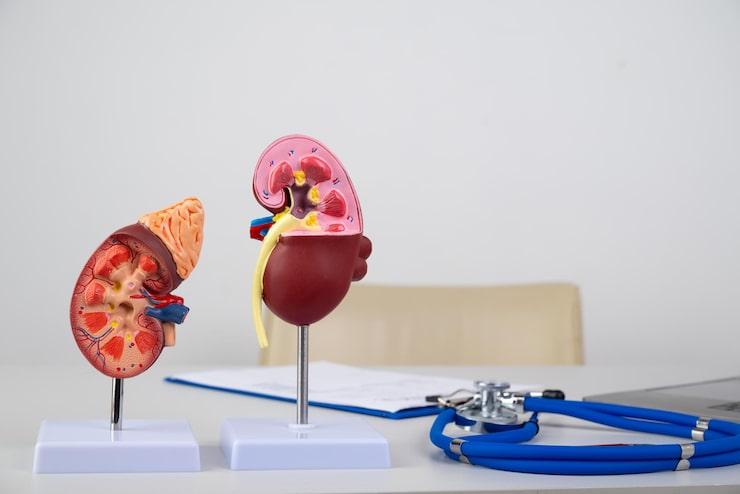
A Basic Guide to Understanding Kidney Stone Removal
Learn the basics of kidney stone removal to be prepared with the guidance of the best in the field from Prakash Hospital.
14 Aug 2025
by Prakash Hospital
From tablets that help a small stone pass to keyhole and laser removal of large ones, treatment is matched to your stone's size, position and hardness.

People who've had kidney stone pain often call it the worst pain of their life. It comes in waves, starting in the back or side under the ribs and shooting down to the groin, and no position makes it better. Vomiting, blood in the urine and a constant urge to pass urine are common. Hot summers, long hours without water and a salty diet make stones especially common in north India.
Stones form when minerals in concentrated urine crystallise, most often as calcium oxalate. Small ones pass down the ureter (the tube from kidney to bladder) on their own. Larger ones get stuck, block the kidney or keep growing silently. Kidney stone treatment has four main options. In order of how invasive they are: tablets that help a stone pass, shock waves from outside the body (ESWL), a thin telescope passed up to the stone so a laser can break it (ureteroscopy), and keyhole removal through the back for large stones (PCNL, percutaneous nephrolithotomy).
With the right choice, most people become stone-free after one procedure, though a large stone sometimes needs a second sitting. Keeping stones away is the harder part: about half of people who have one stone form another within 5 to 10 years unless they change how much they drink and eat.
Our urology department uses imaging to work out each stone's size, position and likely composition, then chooses the least invasive treatment that will work: medical expulsion therapy for small stones, shock wave therapy, ureteroscopy with laser lithotripsy, or PCNL for large stones. Dr. Prabhat Ranjan, our urologist, performs PCNL and ureteroscopy.
Not every stone needs a procedure. An ultrasound or a low-dose CT scan (the most accurate test) shows the stone's size and position and whether the kidney is blocked.
Stones under 5 mm usually pass within a few weeks. For stones of 5 to 10 mm in the lower ureter, tamsulosin relaxes the ureter and improves the odds. You drink plenty, take pain relief and have a repeat scan to check progress.
A machine sends shock waves through the skin, focused on the stone by X-ray or ultrasound. There's no cut, and it's usually day care. It suits stones under about 1 to 1.5 cm in the kidney or upper ureter. Very hard stones, stones low in the kidney and a heavy build make it less effective, and more than one session may be needed.
A thin telescope passes through the urethra and bladder into the ureter, and a laser breaks the stone into dust or small pieces that are removed. A flexible scope can bend up into the kidney itself, a technique called RIRS (retrograde intrarenal surgery), for kidney stones up to about 2 cm. A soft tube called a DJ stent is often left in the ureter for 1 to 3 weeks afterwards.
For kidney stones over about 2 cm, or branching staghorn stones, the urologist makes a track of about 1 cm through the back into the kidney and breaks up and removes the stone through it. Smaller-track versions (mini-PCNL) suit medium-sized stones.
Ureteroscopy and PCNL are done under spinal or general anaesthesia. ESWL usually needs only painkillers or light sedation.
In ureteroscopy, the scope passes up through the urethra and bladder, with no cut on the skin. In PCNL, a needle is guided into the kidney through the back under X-ray, and the track is widened to about 1 cm.
A laser or other energy source breaks the stone into fragments or fine dust. In ESWL, shock waves do this from outside over about 45 to 60 minutes.
Larger pieces are pulled out with a tiny basket or washed out, and a fragment goes for analysis. After ESWL, fragments pass in the urine over the following weeks.
A DJ stent often stays in the ureter while swelling settles, and after PCNL a small tube may drain the kidney for a day or two. A scan a few weeks later confirms you're stone-free, and the stent is removed in a short cystoscopy or by a thread left attached to it.
After ESWL or ureteroscopy, most people go home the same day or next morning, with some blood in the urine and burning. After PCNL you stay 2 to 3 days while the drain comes out.
Drink 2.5 to 3 litres a day. Tamsulosin or painkillers ease stent discomfort. Most people are back at a desk within a few days of ureteroscopy or ESWL, and after 1 to 2 weeks following PCNL.
The stent comes out, often in a quick clinic procedure, so avoid long trips until then. Never leave a stent in beyond the date your urologist gives you. Forgotten stents crust over and can damage the kidney.
Your stone analysis, plus a 24-hour urine test if you've had several stones, guides prevention. Repeat stone formers often have a yearly ultrasound.
Call us on +91-8826000033 or come straight to our 24/7 emergency department.
A small stone sitting in the kidney that causes no pain, infection or blockage can often be watched with a scan every 6 to 12 months.
Uric acid stones, which don't show on plain X-rays, can often be dissolved by making the urine less acidic with potassium citrate tablets. Most other stone types don't dissolve.
Rarely needed now. It's kept for very large or complex stones, or when another problem needs fixing at the same time, such as a narrowed kidney outlet.
Talk to our Urology team
Ask about your options, the cost and your insurance before you decide. See the insurance and TPA panels we work with.
This page explains Kidney Stone Treatment (Laser, PCNL and Shock Wave Therapy) in general terms. Your own plan depends on your health, your test results and your doctor's advice. Please read our medical disclaimer.
Kidney Stone Treatment (Laser, PCNL and Shock Wave Therapy) is led by our Urology team, with other departments stepping in at each stage of your care.
At Prakash Hospital, our Urology Department specializes in diagnosing and treating conditions related to the urinary tract and male reproductive system, offering expert care with advanced surgical and non-surgical solutions.
What the department treats
Laser Lithotripsy
Laparoscopic Urology
Prostate Care
Male Infertility Treatment
Urinary Incontinence Management
Endourology
Procedures often considered alongside Kidney Stone Treatment (Laser, PCNL and Shock Wave Therapy), or that treat related conditions.
A camera test that looks inside the bladder and urethra to find the cause of bleeding, infections or blockage.
Trims an enlarged prostate from inside the urethra so urine flows freely, with no cut on the skin.
Removes a gallbladder with stones through four small cuts, usually with a stay of one night or less.
Other procedures our Urology team performs.
We offer expert care across key specialties, including Medicine, Cardiology, Orthopaedics, ENT, Gynaecology, and more—delivering trusted treatment under one roof.
Free tools to check your weight, plan a pregnancy, track calories and more.
Learn the basics of kidney stone removal to be prepared with the guidance of the best in the field from Prakash Hospital.
14 Aug 2025
by Prakash Hospital

किडनी स्टोन क्यों होता है, इसके लक्षण क्या हैं और बिना सर्जरी किडनी स्टोन का आधुनिक इलाज हिंदी में जानें।
20 Jan 2026
by Prakash Hospital

Prostate problems — symptoms of BPH, prostatitis and prostate cancer, the tests used to diagnose them, and when to see a doctor. Prakash Hospital Noida.
5 Oct 2026
by Prakash Hospital

PCOD problems — the long-term health complications of polycystic ovarian disease and how to prevent them. Visit Prakash Hospital Noida for expert care.
2 Jun 2026
by Prakash Hospital

Think fertility problems are always the woman's issue? Or that stress is to blame? Our specialists at Prakash Hospital, Noida separate common fertility myths from what the medical evidence actually says.
10 Apr 2026
by Prakash Hospital

जानिए ओवेरियन सिस्ट के कारण, लक्षण और उपचार के तरीके। समय पर जांच, सही इलाज और देखभाल से इस समस्या को कैसे नियंत्रित किया जा सकता है, समझें।
12 May 2026
by Prakash Hospital
Learn key insights into prostate health, symptoms, and treatment options with expert urology care from Prakash Hospital, Noida.
23 Oct 2025
by Prakash Hospital

Learn about urinary tract infection (UTI), including symptoms, causes, diagnosis, treatment options, and prevention tips at Prakash Hospital.
17 Feb 2026
by Prakash Hospital
Answers to common questions about Kidney Stone Treatment (Laser, PCNL and Shock Wave Therapy) at Prakash Hospital, Noida.


Book a consultation with Prakash Hospital's specialists — 24/7 emergency care, 100+ doctors, NABH accredited.
View All Departments