


लिगामेंट इंजरी क्या है? (Ligament Tear): कारण, लक्षण और इलाज
जानिए लिगामेंट टियर के कारण, लक्षण और इलाज के तरीके। सही देखभाल, फिजियोथेरेपी और आराम से रिकवरी कैसे तेजी से हो सकती है, समझें।
14 May 2026
by Prakash Hospital
Stitches, reattaches or rebuilds a torn ligament in the knee, ankle, elbow or thumb so the joint holds steady when you put weight or force through it.

A sprained ankle that never quite recovers and turns over on every uneven pavement. A knee that wobbles sideways after a bike accident. A thumb that can't pinch a key after a fall. Ligaments are the tough bands that hold one bone to another, and when one tears completely or heals too loose, the joint stops feeling trustworthy.
Ligament repair surgery covers a group of operations for torn ligaments other than the ACL, which has its own page on ACL reconstruction. A repair stitches the torn ligament or reattaches it to the bone with small anchors. When the ligament is shredded or the tear is old, it's rebuilt with a tendon graft instead, which is called reconstruction.
Many ligament injuries don't need an operation. Most tears of the MCL, on the inner side of the knee, heal in a brace, and most ankle sprains recover with physiotherapy. When surgery is the right call, the joint is usually much steadier, though ligaments heal slowly and full recovery often takes six months or more.
When a tear is likely to heal on its own, our orthopaedics team starts with a brace and physiotherapy. Knee ligament tears that do need surgery, including PCL injuries, are repaired arthroscopically where possible.
An MRI or stress X-rays show which ligament is torn and how badly. Tears are graded from 1 (stretched) to 3 (completely torn), and surgery is mostly for grade 3 tears like these.
A repair uses your own ligament and succeeds most often within a few weeks of the injury, before the tissue shrinks back. Reconstruction replaces it with a graft, usually a hamstring tendon from your own leg, for old tears or tissue too damaged to stitch. A repair is sometimes reinforced with strong suture tape.
Ligaments inside the knee, such as the PCL, are usually treated arthroscopically. Those on the outside of a joint, at the ankle, thumb or outer knee, are reached through a small cut directly over them.
If the ligament has torn off with a piece of bone (an avulsion), the fragment is put back and held with a screw, wire or strong stitches. Bone heals well to bone, so these injuries often do well when fixed early.
Knee and ankle operations are usually done under spinal or general anaesthesia. Thumb and elbow repairs may be done under a nerve block that numbs just the arm.
The surgeon tests how loose the joint is under anaesthesia and, for the knee, often looks inside with an arthroscope to check the meniscus and cartilage.
For outer ligaments, a small cut is made over the tear. Nerves that run close by, such as the peroneal nerve at the outer knee, are found and protected.
The torn ends are stitched, or the ligament is fixed back to bone with small anchors carrying strong sutures. A graft, if needed, is fixed through tunnels in the bone.
The wound is closed and the joint goes into a cast, splint or hinged brace set at a safe angle. Surgery takes 1 to 3 hours, depending on how many ligaments are involved.
Ligaments have a poor blood supply, so they heal slowly. The joint is protected first, then movement is brought back gradually so the healing tissue isn't stretched out.
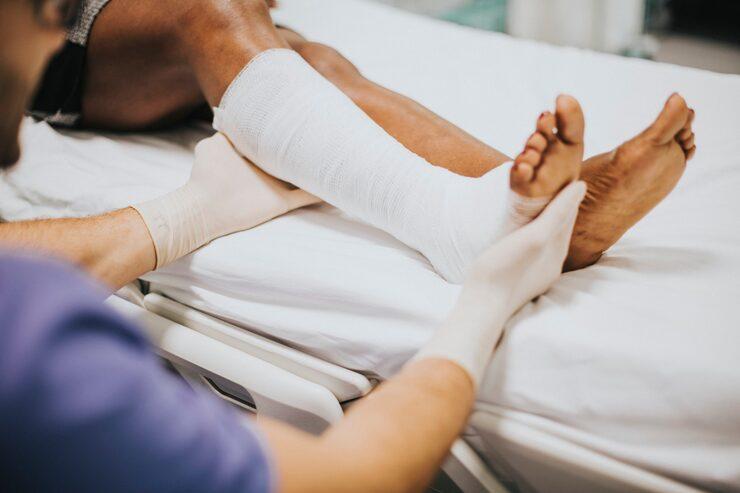
Keep the limb raised and use ice. You'll be on crutches after leg surgery, or have your hand or elbow in a splint. Stitches usually come out at around 2 weeks.
The joint stays protected in a cast, splint or hinged brace for 2 to 6 weeks in total, depending on the joint. Many repairs allow controlled movement within the brace, guided by your physiotherapist.
The brace comes off and you put more weight through the limb. Physiotherapy works on range of movement, strength and balance.
A gradual return to running, sport and heavy work. Ankle and thumb repairs often recover in about 3 months, while multi-ligament knee injuries can take 9 months to a year.
Call us on +91-8826000033 or come straight to our 24/7 emergency department.
This is the main treatment for most MCL tears, partial tears and first-time ankle sprains. A hinged brace protects the ligament while it heals over about 6 weeks, and exercises rebuild strength and balance.
Wobble-board work and strengthening the muscles on the outer side of the lower leg stop the ankle rolling for most people, with an ankle brace for sport. Surgery is kept for those who still give way after 3 to 6 months.
Many people with a PCL tear on its own do well with a strong thigh muscle and never need an operation.
Talk to our Orthopedics & Joint Replacement team
Ask about your options, the cost and your insurance before you decide. See the insurance and TPA panels we work with.
This page explains Ligament Repair Surgery in general terms. Your own plan depends on your health, your test results and your doctor's advice. Please read our medical disclaimer.
Ligament Repair Surgery is led by our Orthopedics & Joint Replacement team, with other departments stepping in at each stage of your care.
At Prakash Hospital, our Orthopedics and Traumatology Department offers expert diagnosis, surgical and non-surgical treatments, and rehabilitation for bone, joint, and musculoskeletal injuries.
What the department treats
Total Knee Replacement
Total Hip Replacement
Arthroscopic Surgery
Spine Surgery
Trauma and Fracture Care
Sports Medicine
Runs brace-and-exercise treatment for tears that don't need surgery, and staged rehab for those that do.
Does the MRI and stress X-rays that show which ligaments are torn and how badly.
Assesses fresh injuries, checks for fractures, dislocations and blood vessel damage, and splints the joint.
Procedures often considered alongside Ligament Repair Surgery, or that treat related conditions.
Rebuilds a torn ACL with a tendon graft through keyhole surgery to stop the knee giving way.
Keyhole surgery using a thin camera to diagnose and repair problems inside the knee or shoulder.
Realigns broken bones and holds them with plates, screws, rods or frames so they heal in the right position.
Realigns and rebuilds a joint damaged by injury, deformity or earlier surgery, keeping your own joint.
Other procedures our Orthopedics & Joint Replacement team performs.
Replaces a knee worn out by arthritis with a metal and plastic joint to relieve pain and get you walking again.
Replaces a worn or collapsed hip ball and socket with an artificial joint to end groin pain and restore walking.
Replaces a damaged shoulder ball and socket to relieve arthritis pain and help you use your arm again.
Frees a trapped spinal nerve by removing slipped disc or bone, easing sciatica and leg pain.
Replaces a failed knee implant that is loose, worn, infected or unstable with new revision parts.
Replaces only the worn part of an arthritic knee, keeping the healthy cartilage and ligaments.
We offer expert care across key specialties, including Medicine, Cardiology, Orthopaedics, ENT, Gynaecology, and more—delivering trusted treatment under one roof.
Free tools to check your weight, plan a pregnancy, track calories and more.
जानिए लिगामेंट टियर के कारण, लक्षण और इलाज के तरीके। सही देखभाल, फिजियोथेरेपी और आराम से रिकवरी कैसे तेजी से हो सकती है, समझें।
14 May 2026
by Prakash Hospital
Understand avulsion fractures, their symptoms, and treatment options with expert orthopedic care from Prakash Hospital, Noida.
15 Oct 2025
by Prakash Hospital

जानिए स्पोर्ट्स इंजरी क्यों होती है, इससे कैसे बचा जा सकता है और चोट लगने पर क्या करना चाहिए।
6 Apr 2026
by Prakash Hospital

ज्यादा नमक खाने से क्या नुकसान होते हैं? जानिए हाई ब्लड प्रेशर, किडनी और दिल पर नमक का प्रभाव और रोजाना कितना नमक सुरक्षित है।
10 Mar 2026
by Prakash Hospital
Support fracture recovery with essential nutrients like calcium, vitamin D, and protein for faster bone healing.
19 Nov 2025
by Prakash Hospital

Magnesium deficiency symptoms like cramps, poor sleep and anxiety, why it is common in India, and the best Indian foods for magnesium. Prakash Hospital Noida.
1 Oct 2026
by Prakash Hospital

Compound Bone Fracture क्या है, इसके लक्षण, इलाज के तरीके, सर्जरी, सावधानियां और पूरी रिकवरी प्रक्रिया जानें इस विस्तृत हिंदी गाइड में।
30 Dec 2025
by Prakash Hospital

Learn about bone fractures in adults including types of fractures, causes, symptoms, diagnosis, treatment options at Prakash Hospital.
23 Feb 2026
by Prakash Hospital

Learn about the most common knee injuries in sports, their symptoms, and effective treatment methods to ensure a safe return to activity.
5 May 2025
by Prakash Hospital
Answers to common questions about Ligament Repair Surgery at Prakash Hospital, Noida.


Book a consultation with Prakash Hospital's specialists — 24/7 emergency care, 100+ doctors, NABH accredited.
View All Departments