



Critical Facts About Peripheral Angiogram You Should Know
Understand what a peripheral angiogram is, when it’s needed, and how it helps detect circulation issues. Learn about the procedure, benefits, and risks.
14 May 2025
by Prakash Hospital
An X-ray dye test that shows exactly where your heart's arteries are narrowed and how badly, so your cardiologist can plan the right treatment.

Chest tightness when you climb stairs, an abnormal treadmill test, breathlessness that doesn't add up. They can all lead to the same question: are the arteries that feed your heart narrowed, and if so, where?
Coronary angiography answers that directly. A cardiologist passes a thin, flexible tube called a catheter through an artery in your wrist or groin up to your heart, then injects a dye into the coronary arteries. X-ray pictures taken as the dye flows show each narrowing, how tight it is and how many vessels are involved. The pictures themselves are called a coronary angiogram.
It is a test, not a treatment. But if it finds a severe blockage, angioplasty with a stent can often be done in the same sitting through the same tube, provided you have agreed to that beforehand.
Our cardiology team performs angiography alongside ECG, echocardiography, treadmill testing and Holter monitoring, so the tests before and after your angiogram happen under one roof.
Your cardiologist may suggest an angiogram when other tests point to coronary artery disease, or when there's no time for other tests at all, as during a heart attack.
The catheter goes in through the artery at your wrist. You can usually sit up soon afterwards, and bleeding problems are less common, so this is the first choice for most patients.
The large artery at the top of the thigh is used when the wrist artery is too small or twisted, or when bigger equipment is needed. You'll need to lie flat for a few hours afterwards.
You lie on a narrow table under the X-ray camera. ECG stickers go on your chest and a drip goes into your arm, and you may be given a mild sedative. You stay awake so you can follow instructions.
The skin over your wrist or groin is numbed with local anaesthetic, and a short plastic sheath is placed in the artery. You'll feel pressure but not sharp pain.
A thin catheter is passed through the sheath and steered to the openings of your coronary arteries using live X-ray images. You won't feel it moving, because the inside of the blood vessels has no pain nerves.
Dye is injected into each artery while the camera moves around you to film it from several angles. You may feel a warm flush for a few seconds, or be asked to hold your breath.
The catheter and sheath come out. At the wrist, a tight band goes over the puncture and is loosened gradually over a few hours. At the groin, firm pressure or a small closure device seals the artery.
Your cardiologist usually talks you through the findings the same day, often with the pictures on screen. The report covers each of the main arteries (the left main, the left anterior descending, the circumflex and the right coronary artery) and gives the narrowing in each as a percentage.
Narrowing below about 50% is usually treated with medicines and lifestyle changes. A narrowing of 70% or more in a major artery, especially if you have symptoms, is considered significant. Borderline narrowings in between sometimes need a pressure-wire measurement to decide whether they really limit blood flow.
From that pattern, the choice is usually between medicines alone, angioplasty, or bypass surgery (CABG) when the disease involves several arteries or the left main artery. A normal angiogram is good news too: it rules out significant blockages and can save you from more tests.
You rest while nurses check the puncture site, pulse and blood pressure. After a wrist approach you can usually sit up straight away. After a groin approach you lie flat for 2 to 4 hours. Drink plenty of water to flush out the dye.
Most people go home the same day or the next morning, depending on the findings and whether a stent was placed.
Don't lift anything heavy with the treated arm, or strain if the groin was used, for about 5 to 7 days. Keep the site dry for a day. Most people are back at desk work in 2 to 3 days.
Your cardiologist will go over the treatment plan and arrange a review. If you smoke, or have diabetes or high cholesterol, this is the time to take them seriously.
Call us on +91-8826000033 or come straight to our 24/7 emergency department.
Shows whether your heart runs short of blood during exercise. It's a good first test for many people, but it can't show where a blockage is.
An ultrasound of the heart that shows its pumping and valves. Weak areas of heart muscle can hint at a blocked artery, but the arteries themselves aren't visible.
A scan with dye injected into an arm vein instead of a catheter. It's good at ruling out disease in lower-risk people, but a significant blockage found this way usually still needs a catheter angiogram before treatment.
Talk to our Cardiology team
Ask about your options, the cost and your insurance before you decide. See the insurance and TPA panels we work with.
This page explains Coronary Angiography in general terms. Your own plan depends on your health, your test results and your doctor's advice. Please read our medical disclaimer.
Coronary Angiography is led by our Cardiology team, with other departments stepping in at each stage of your care.
At Prakash Hospital, our Cardiology Department offers expert, round-the-clock care, providing timely diagnosis and advanced treatments for heart conditions to keep your heart healthy and strong.
What the department treats
Interventional Cardiology
Echocardiography
Cardiac Rehabilitation
Pacemaker Implantation
Angioplasty and Stenting
Heart Failure Management
Procedures often considered alongside Coronary Angiography, or that treat related conditions.
Opens a narrowed or blocked heart artery with a balloon and a stent, passed up from the wrist or groin.
An ECG recorded while you walk on a treadmill, to check for reduced blood flow to the heart during exercise.
An ultrasound of the heart that shows how well it pumps and how the valves work. Painless and radiation-free.
Measures pressure and oxygen inside the heart and lungs through a thin tube, to guide valve and heart failure care.
A portable ECG worn for 24 to 48 hours to catch irregular heartbeats that come and go.
Round-the-clock emergency scans and treatment for stroke, followed by rehabilitation and prevention.
Other procedures our Cardiology team performs.
We offer expert care across key specialties, including Medicine, Cardiology, Orthopaedics, ENT, Gynaecology, and more—delivering trusted treatment under one roof.
Free tools to check your weight, plan a pregnancy, track calories and more.
Understand what a peripheral angiogram is, when it’s needed, and how it helps detect circulation issues. Learn about the procedure, benefits, and risks.
14 May 2025
by Prakash Hospital

Understand the critical difference between a heart attack and cardiac arrest, their symptoms, causes, emergency response steps, and treatment options. Learn when to seek urgent help from expert cardiologists at Prakash Hospital.
8 Dec 2025
by Prakash Hospital
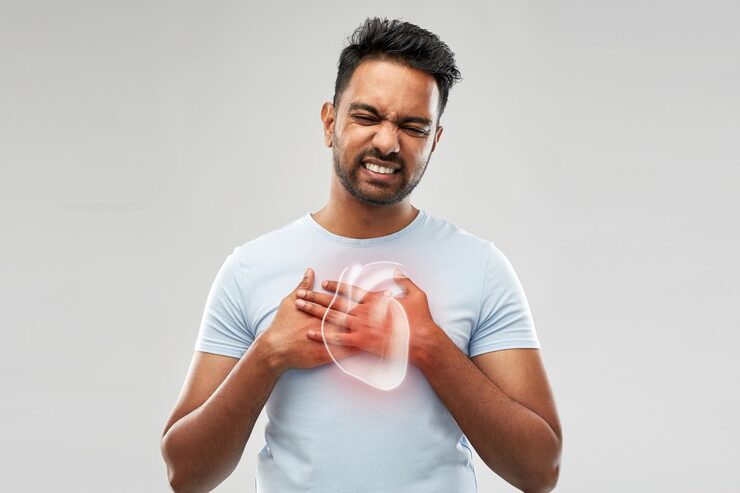
Heart attack warning signs in men and women, what to do immediately, and how to reduce risk. Visit Prakash Hospital Noida for cardiac care.
22 Jul 2026
by Prakash Hospital

विटामिन A, B12, C, D की कमी से कौन सी बीमारियां होती हैं? जानें लक्षण, कारण और बचाव के उपाय। Prakash Hospital में पाएं पूरी न्यूट्रिशन जांच और परामर्श।
11 Jun 2026
by Prakash Hospital

Iron-rich foods — the best sources to boost hemoglobin, prevent anaemia, and stay energetic. Visit Prakash Hospital Noida for blood tests and nutrition care.
29 Jun 2026
by Prakash Hospital

Discover a complete diet plan for diabetic patients, including foods to eat, foods to avoid, meal tips, and blood sugar control at Prakash Hospital.
16 Feb 2026
by Prakash Hospital

Learn symptoms, risk factors, prevention tips and when to seek expert cardiac care in Noida.
25 Mar 2026
by Prakash Hospital

Learn how stress affects heart health and discover simple daily habits to stay calm and protect your heart.
5 Aug 2025
by Prakash Hospital

Discover how sleep apnoea silently harms your heart and brain. Learn its symptoms, risks, and treatment options at Prakash Hospitals.
3 Nov 2025
by Prakash Hospital
Answers to common questions about Coronary Angiography at Prakash Hospital, Noida.


Book a consultation with Prakash Hospital's specialists — 24/7 emergency care, 100+ doctors, NABH accredited.
View All Departments