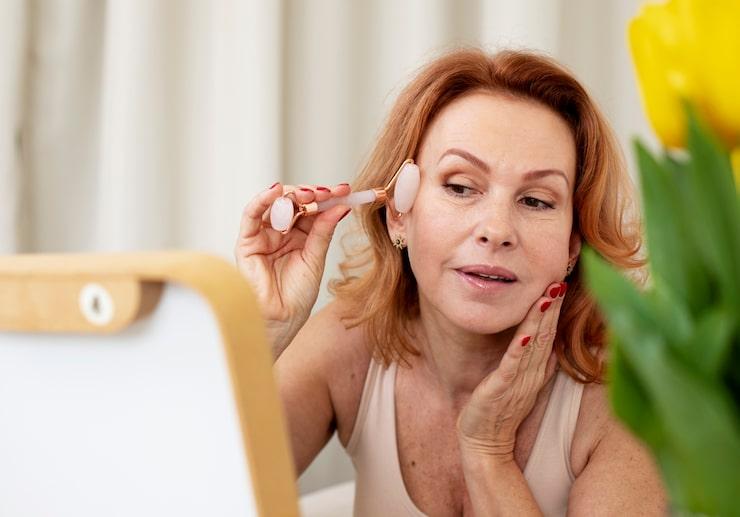
A woman looking in mirror at dark circles under eyes
Dark circles are one of the most common cosmetic concerns in India, and one of the most frustrating — because the same dark circle can have multiple different causes, and the treatment that works for one cause does nothing for another.
The person with dark circles from sleep deprivation and stress needs very different management from the one with pigmentation from UV exposure or iron deficiency, or from the one with structural hollowness under the eye from volume loss. Understanding which type you have — or which combination — is what makes treatment effective rather than a waste of money.
The skin under the eye is the thinnest on the body — approximately 0.5 mm thick compared to 2 mm elsewhere. This thinness means that structures underneath — blood vessels, the orbicularis oculi muscle, and the underlying bone — are more visible here than anywhere else. Dark circles are almost always a result of what's showing through this thin skin, rather than something wrong with the skin itself.
The most common type in South Asians. The skin under the eye has increased melanin production (hyperpigmentation), making it genuinely darker than surrounding skin. This is often:
Appearance: clearly brown or dark brown in colour; uniform; more prominent when the skin is stretched.
The thin under-eye skin allows the blue-purple colour of blood in the periorbital blood vessels and muscle to show through. This is more prominent when:
Appearance: blue, purple, or dark purple tones, not brown. Often worse in the morning or after poor sleep.
As we age (or sometimes even in young people with naturally deep-set eyes), the fat pad under the eye thins and descends, creating a hollow (tear trough). This hollow creates a shadow that appears as a dark circle — it's not pigmentation or blood vessels, it's literally a shadow.
Appearance: appears as a shadow; changes with lighting direction; a light angled from above makes it more prominent; most prominent when looking straight ahead.
Cucumber slices: the cooling sensation reduces puffiness temporarily through vasoconstriction. The dark circle itself is unchanged. Harmless, mildly helpful for the puffy component. Not a treatment.
Cold milk or tea bags: same principle — cooling reduces vascular dilation and puffiness temporarily. Soothing; not curative.
Most commercial eye creams with vague "brightening" claims: many contain caffeine (temporarily reduces puffiness by vasoconstriction), retinol (some evidence for skin thickening), and vitamin C (antioxidant). Caffeine provides temporary improvement; retinol and vitamin C have modest evidence for pigmented circles with consistent long-term use.
Sunscreen consistently applied under the eyes: UV protection prevents UV-driven melanin stimulation. A broad-spectrum SPF 30–50 applied to the entire face including the periorbital area every morning (and reapplied when outdoors) is the single most preventive measure.
Vitamin C serum: applied to the under-eye area consistently over 3–6 months, vitamin C inhibits melanin production (through tyrosinase inhibition) and reduces oxidative damage to the skin. Use a stable vitamin C formulation (L-ascorbic acid in a dark glass bottle or encapsulated form). Apply before sunscreen.
Niacinamide: a form of vitamin B3. Reduces melanin transfer to skin cells. Available in topical serums, typically 5%. Gentle, well-tolerated, effective for pigmented circles with 8–12 weeks of consistent use.
Retinol (vitamin A derivative): increases skin cell turnover, gradually reducing hyperpigmentation. Start with a low concentration (0.025–0.05%). Apply at night only (retinol increases UV sensitivity — critical to use sunscreen the next morning). Takes 3–6 months for visible improvement.
Kojic acid or arbutin serums: tyrosinase inhibitors — reduce melanin production. Evidence-based for hyperpigmentation; gentler alternatives to hydroquinone.
Hydroquinone: a prescription-strength skin-lightening agent. The most potent readily available option for resistant hyperpigmentation. Should be used under dermatologist guidance — can cause ochronosis (bluish-black pigmentation) with very prolonged overuse.
Chemical peels (glycolic acid, lactic acid): done by dermatologists. Remove the superficial pigmented skin layers. Multiple sessions needed. Short downtime. Effective for pigmented dark circles.
Laser treatments: Q-switched Nd:YAG laser or fractional laser — target melanin precisely. Effective for treatment-resistant pigmented circles. Multiple sessions at a dermatology clinic.
Adequate sleep (7–8 hours consistently): the most effective treatment for vascular dark circles driven by sleep deprivation.
Cold compresses: reduce vessel dilation and puffiness.
Elevating the head during sleep: reduces fluid accumulation under the eyes.
Treating allergic rhinitis: antihistamines (cetirizine, loratadine), nasal corticosteroids (mometasone nasal spray), and allergen avoidance reduce the nasal congestion-mediated venous backup.
Vitamin K topical cream: some evidence that vitamin K reduces periorbital bruising and vascular circles by reducing vessel fragility. Limited trial data but reasonable mechanism.
Caffeine-containing eye creams: temporary vasoconstriction. Useful for mornings when puffiness is pronounced.
Hyaluronic acid filler injections (tear trough filler): the most effective treatment for structural hollowing. A dermatologist or plastic surgeon injects hyaluronic acid gel into the tear trough to restore volume. Results are immediate and last 12–18 months. Requires skill — done incorrectly, it can cause the Tyndall effect (bluish discolouration from superficially placed filler).
Retinol: by thickening the skin over time, it makes the underlying structures less visible. A long-term approach.
Facial exercises: claimed to improve facial fat distribution — evidence is very limited.
Dermatology consultation for chemical peels, laser treatment, or tear trough filler when home and medical approaches are insufficient.
At Prakash Hospital Noida, our physicians assess medical contributors to dark circles — iron deficiency, thyroid function, and allergic conditions — alongside dermatology referral for pigmentation treatment and cosmetic procedures.
Whether you live in Sector 18, Sector 62, Greater Noida West, or anywhere in the NCR, Prakash Hospital Noida is a trusted name for dark circles, skin health, and general medicine in Noida.
Tags: #HowToReduceDarkCircles #DarkCirclesTreatment #PrakashHospitalNoida
 Copy
CopyWe offer expert care across key specialties, including Medicine, Cardiology, Orthopaedics, ENT, Gynaecology, and more—delivering trusted treatment under one roof.


Book a consultation with Prakash Hospital's specialists — 24/7 emergency care, 100+ doctors, NABH accredited.

Prakash Hospital Pvt. Ltd. is a 100 bedded NABH NABL accredited multispecialty hospital along with a center of trauma and orthopedics. We are in the service of society since 2001.
OUR SPECIALITIES
Patient Services
PROCEDURES
Contact Us
D – 12A, 12B, Sector-33, G. B. Nagar, Noida, Uttar Pradesh 201301
+91-8826000033


© 2026 All rights reserved.
Designed and Developed by Zarle Infotech